HAZELWOOD NEEDS NOTHING BUT A 64
Hazelwood started out leaning on a RAM Expansion Unit. The REU kept the realm in memory and slid one screen into the next in an instant. It worked, but it meant you needed an REU, or a cartridge that pretends to be one, to play.
We didn't like that. A game for the 64 should run on a 64.
The slide
The hard part was the screen slide: when you walk off the edge, the next screen pushes the old one away. The REU did that for free. Without it, the 6510 has to move every byte itself, fast enough not to judder.
We built three prototypes. The first moved two columns every two frames and didn't look good. The second moved a column a frame with unrolled code and was better. The third is the one in the game: a pixel-smooth slide, four pixels a frame, with the fine scroll timed so it doesn't jitter on a real machine.
Loading as you walk
The rest of the REU's job now falls to the disk. Every place in Hazelwood (each town, cave, field and sanctuary) loads as you walk into it, along with its people, its creatures and its music. That's how a whole realm fits in 64K.
What it runs on
- Any Commodore 64, PAL or NTSC.
- No RAM expansion, no fast loader.
- One D81 disk image, made for the Kung Fu Flash, SD2IEC and the like.
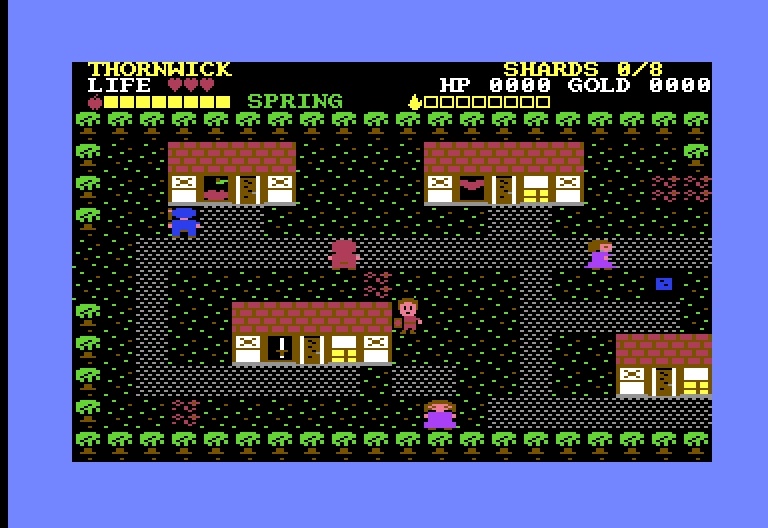
Since the switch we've had notes from play on a real 64: the slide's timing, the colour of the water's ripples, the townsfolk blending into the ground. All fixed. Next come spells, inns, seasons and weather.